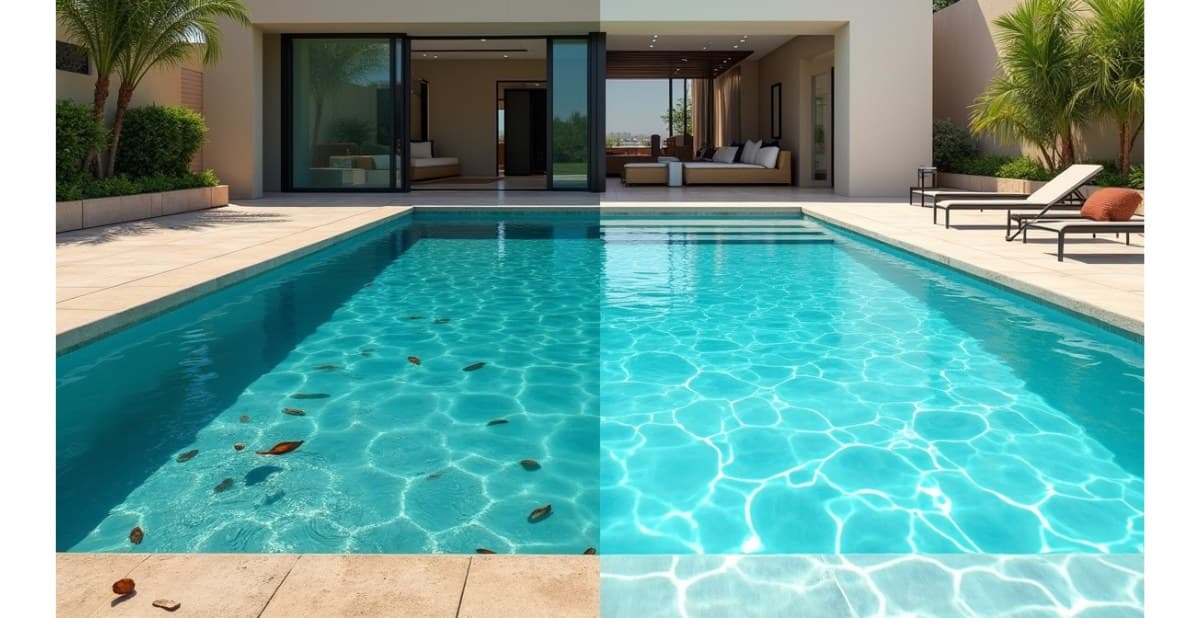
Introduction
A swimming pool in Dubai is more than a luxury feature. It is a mechanical and water-treatment system that needs regular attention to remain clean, safe, efficient, and ready for use. Why Annual Maintenance Contracts (AMC) Are Important for Dubai Pools becomes especially clear when you consider the local climate: Dubai experiences hot, humid summers, strong sunlight, dust, and long periods when outdoor pools may be used frequently.
An annual maintenance contract creates a planned routine instead of waiting until the water turns cloudy, algae appears, a pump stops working, or a small leak becomes expensive.
A professional contract can cover scheduled cleaning, water testing, chemical balancing, filter care, equipment inspections, preventive maintenance, reporting, and agreed emergency support. However, not every AMC offers the same level of service.
This guide explains what a Dubai pool maintenance contract should accomplish, what it should include, how often a pool needs attention, what homeowners should check before signing, and how preventive care can protect the long-term value of the entire pool system.
What Is a Pool AMC?
An annual maintenance contract is a service agreement between a pool owner and a maintenance provider covering agreed maintenance activities over a defined period, usually one year.
Instead of arranging individual visits whenever something goes wrong, the homeowner has a planned schedule for routine care. Depending on the contract, visits may be weekly, biweekly, monthly, or customized around the pool's size, usage, equipment, and condition.
The important word is scheduled.
A good AMC is not simply a promise that someone will clean the pool. It is a preventive-maintenance program designed to identify developing problems before they become major failures.
Current Dubai service providers commonly advertise combinations of water testing, chemical balancing, skimming, brushing, vacuuming, filter maintenance, equipment inspection, reporting, and emergency support. However, the exact scope differs significantly between companies.
A typical AMC may cover:
Routine pool cleaning
Water testing and chemical adjustment
Skimming and vacuuming
Wall and floor brushing
Filter inspection and backwashing
Pump and circulation checks
Skimmer and basket cleaning
Water-level monitoring
Equipment inspection
Leak observation
Algae prevention
Periodic deep cleaning
Maintenance reports
Priority support, where included
Homeowners should always request the exact scope in writing. "Full maintenance" can mean very different things from one company to another.
Why Dubai's Climate Makes Consistent Care Important
Dubai's environment creates a demanding operating condition for outdoor swimming pools. Official Dubai information describes the city's summers as extremely hot and humid, with high sunshine exposure throughout the year.
Heat and sunlight affect water treatment, while dust and debris increase the cleaning load. Humidity and outdoor exposure can also affect surrounding surfaces and equipment spaces.
This does not mean a pool needs constant chemical treatment without measurement. It means its condition should be monitored consistently.
A neglected pool can move from apparently normal to problematic surprisingly quickly. Reduced circulation, incorrect chemical balance, clogged filters, or inadequate sanitation can create a chain reaction.
What a Professional AMC Should Include
The value of an annual contract depends largely on its scope. A low-cost plan that only skims the water may not provide the preventive protection a homeowner expects.
Before signing, separate the service into routine care, preventive maintenance, repairs, consumables, and emergency support.
For example, some Dubai providers advertise routine water balancing and cleaning as standard while treating replacement parts, major repairs, or specialized equipment work separately.
An experienced provider should also understand that every pool is different. A villa pool with daily family use does not have the same requirements as a rarely used holiday-home pool.
The contract should therefore be based on actual conditions rather than a generic checklist.
Water Chemistry: The Foundation of Pool Health
Clear water does not automatically mean chemically balanced water. Proper sanitation and pH control are central to swimmer comfort, surface protection, and effective disinfection.
The CDC identifies chlorine and pH as key components of residential pool water treatment and recommends routine testing. Its guidance gives a pH range of 7.0–7.8 and notes that sunlight, dirt, swimmer waste, and other factors can reduce chlorine levels.
An AMC gives the homeowner a practical way to turn this principle into a routine.
Technicians can record readings, identify trends, and adjust treatment according to the pool's actual condition instead of adding chemicals blindly.
Important parameters may include:
pH
Free chlorine or other sanitizer level
Total alkalinity
Calcium hardness
Stabilizer where applicable
Salt concentration for salt-chlorinated systems
Water clarity
Temperature
Equipment operating readings
The correct targets can depend on the treatment system, pool finish, equipment, and applicable local requirements, so the service provider should document the operating parameters being used.
Why records matter
Imagine that a pool repeatedly needs unusually large chemical adjustments. A good technician should not simply keep adding chemicals. The pattern may indicate a circulation problem, dosing issue, filtration weakness, excessive contamination, or another underlying condition.
That is the difference between reactive cleaning and professional pool management.
Equipment Maintenance and Preventive Repairs
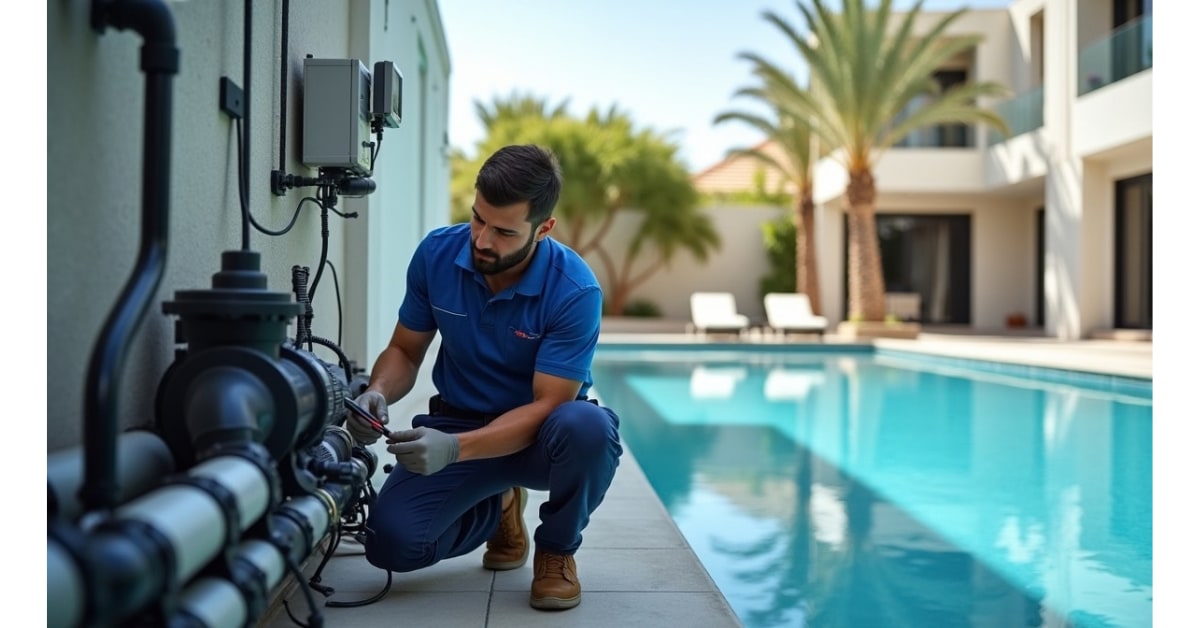
The pool surface is visible, but much of the system's performance depends on equipment hidden inside the plant room.
Pumps, filters, valves, dosing systems, heaters, chillers, automation controllers, lights, sensors, and electrical components all require appropriate inspection.
A small issue can become expensive when ignored. A pump running under abnormal conditions, for example, may continue operating while performance deteriorates. A filter with increasing pressure may need cleaning or investigation. A dosing system that is not calibrated correctly can affect water chemistry.
Professional preventive-maintenance guidance also recommends inspecting equipment and replacing certain components before failure rather than waiting for breakdowns.
Ask your maintenance provider to check:
Pump operation and unusual noise.
Filter pressure and condition.
Valves and visible pipe connections.
Skimmer and pump baskets.
Chemical dosing equipment.
Sensors and controllers.
Pool lights and accessible electrical components.
Heater or chiller operation, where installed.
Automation settings and timers.
Visible leaks or abnormal water loss.
A good AMC should create a maintenance trail. Over time, those observations can help identify gradual deterioration before it becomes a major repair.
Cleaning, Filtration, and Algae Prevention
Cleaning is one of the most visible parts of pool maintenance, but it should never be confused with the complete maintenance process.
Skimming removes floating debris. Brushing helps remove material from surfaces. Vacuuming removes settled dirt. Filtration captures suspended particles. Water treatment controls microorganisms and helps maintain suitable swimming conditions.
All of these functions work together.
Dubai's dusty environment makes filtration particularly important for outdoor pools. If debris is allowed to accumulate, the filter and circulation system can carry a heavier load, while organic material can contribute to water-quality problems.
A practical maintenance cycle
Every scheduled visit: inspect the pool, test water, remove debris, and perform agreed cleaning.
Periodically: inspect filter condition, clean baskets, backwash or clean the filter according to its type and operating pressure, and check equipment.
Seasonally: review the complete system before periods of heavier use or extended absence.
Annually: conduct a deeper condition assessment of equipment, surfaces, controls, and maintenance history.
The exact frequency should be adjusted according to usage, weather, pool size, equipment, and water condition.
If algae appears, simply adding chemicals may not solve the underlying problem. Circulation, filtration, sanitation, and surface cleaning should all be checked.
How an AMC Can Control Long-Term Costs
The financial value of preventive maintenance is not that an AMC eliminates every repair. It is that it can reduce avoidable deterioration and make maintenance spending more predictable.
A neglected pool may eventually require emergency cleaning, algae treatment, equipment repair, surface restoration, or multiple technician visits. Planned care can identify some issues while they are still manageable.
Consider two scenarios.
Reactive maintenance
The owner notices cloudy water → calls a technician → the technician discovers poor filtration → the filter requires service → the water needs treatment → the pool remains unavailable during corrective work.
Preventive maintenance
Routine inspection shows increasing filter pressure → technician records the change → filter is serviced → circulation returns to normal → water remains stable.
The second scenario does not guarantee zero costs. It simply demonstrates why identifying problems early can be more efficient.
Current Dubai AMC providers advertise different pricing structures and service frequencies, which shows why homeowners should compare scope rather than headline price.
Choosing the Right Service Frequency
Not every Dubai pool needs the same number of visits.
A heavily used family pool may need more frequent attention than a property that is occupied occasionally. A pool with automation can reduce some manual tasks, but automation does not remove the need for inspection and verification.
Several Dubai maintenance companies currently offer weekly, bi-weekly, and monthly service structures, with higher-frequency packages generally covering more regular intervention.
Frequency should depend on:
Pool size
Number of swimmers
Frequency of use
Outdoor exposure
Landscaping around the pool
Filtration system
Chemical-treatment method
Automation level
Water temperature
Presence of a pool cover
Property occupancy
Current equipment condition
For a frequently used villa pool, weekly professional attention may be a practical baseline, with additional monitoring during demanding periods.
For a property that is empty for extended periods, the priority changes: the service provider needs to maintain circulation, water chemistry, equipment operation, and early-warning checks while the owner is away.
The contract should describe what happens when the property is vacant rather than assuming normal usage.
How to Compare Pool AMC Contracts
The cheapest annual contract is not automatically the best-value contract. Likewise, the most expensive package may include services your pool does not need.
The best comparison starts with a written scope.
Ask each company to answer the same questions.
AMC comparison checklist
1. How many visits are included?
Do not accept "regular visits" without a defined frequency.
2. What happens during each visit?
Ask for the actual task list.
3. Which chemicals are included?
Confirm whether standard chemicals are included or charged separately.
4. Are spare parts included?
Usually, major replacement parts are treated separately, but the contract should state this clearly.
5. Is emergency support included?
Ask about response times, callout charges, and after-hours support.
6. Are equipment inspections included?
A cleaning-only package is different from a complete preventive-maintenance agreement.
7. Do you receive reports?
Reports should ideally contain readings, observations, completed tasks, and recommendations.
8. Who performs specialist repairs?
Find out whether equipment work is handled by the maintenance company or subcontracted.
9. Is there a condition assessment before the contract begins?
This is particularly important for older pools.
10. What happens when the contract ends?
Understand renewal terms, outstanding repairs, and handover documentation.
A professional provider should be comfortable explaining exclusions. Clear exclusions are better than vague promises.
10. Why Maintenance Records and Reporting Matter
One of the most overlooked benefits of a professional maintenance program is documentation.
A report after each visit creates a timeline of what happened to the pool. Over several months, patterns become visible.
For example, repeated increases in filter pressure may suggest filtration issues. Repeated water-level loss may justify leak investigation. Frequent chemical corrections may indicate a dosing or circulation problem.
This turns maintenance from a series of isolated visits into a measurable process.
A useful service report can include:
Report item
Example information
Visit date
Date and technician
Water readings
pH and sanitizer results
Cleaning completed
Skimming, brushing, vacuuming
Filter status
Pressure/backwash condition
Equipment
Pump, dosing, heater/chiller observations
Pool condition
Tiles, waterline, visible defects
Water level
Normal or unusual loss
Recommendations
Repairs or follow-up required
Photos
Before/after or equipment evidence
Next action
Scheduled service or approved repair
This is particularly useful for homeowners who travel frequently or manage multiple properties.
It also gives the owner a record when discussing future repairs, renovations, or equipment upgrades.
Dubai Municipality provides official swimming-pool approval services and technical requirements, while professional operators should still ensure their maintenance procedures and documentation reflect the applicable requirements for the particular property and pool.
For owners planning a renovation, documented maintenance history can also help a contractor understand how the existing system has performed.
FAQs
Is a pool AMC worth it in Dubai?
For owners who want consistent professional care, an AMC can make routine maintenance more predictable and help identify developing problems earlier.
How often should a Dubai swimming pool be serviced?
The ideal frequency depends on usage, pool size, equipment, and conditions; many professional plans offer weekly or biweekly service options.
Does an AMC include pool chemicals?
It depends on the contract. Always confirm which chemicals and consumables are included before signing.
Does an AMC cover pump or filter repairs?
Routine inspection may be included, but replacement parts and major repairs are often separate; the written contract should specify this clearly.
Can a pool AMC help prevent green water?
Regular cleaning, filtration checks, and water-chemistry monitoring can reduce the conditions that contribute to algae and poor water quality, but no maintenance plan can guarantee that problems will never occur.
Conclusion
A swimming pool should not be treated as something that only needs attention when it looks dirty. It is a complete water-treatment, circulation, and mechanical system, and its condition can change gradually long before a visible failure appears.
That is the real value behind Why Annual Maintenance Contracts (AMC) Are Important for Dubai Pools. Consistent professional service creates a routine for water testing, cleaning, filtration, equipment inspection, and preventive maintenance. In Dubai's hot and humid environment, that consistency can be particularly valuable.
The most important step is to choose the contract carefully. Compare visit frequency, water testing, cleaning tasks, equipment inspections, chemicals, emergency response, reporting, repair charges, and exclusions—not simply the annual price.
For a new or existing pool, start with a professional condition assessment and request a detailed written AMC scope. You can also explore BAB ALFIZA's pool services for ongoing pool care or review its Pool MEP & Pump Room services when equipment performance is part of the maintenance requirement. For older pools with recurring problems, pool renovation and resurfacing services may be worth assessing before committing to routine maintenance.
Actionable next step: ask your pool provider for a written 12-month maintenance schedule, an itemized list of inclusions and exclusions, and a sample service report before signing the contract.
Author Bio
BAB ALFIZA Pool Experts creates practical swimming-pool content for Dubai and the UAE, covering pool construction, maintenance, renovation, water treatment, equipment, and outdoor aquatic systems. BAB ALFIZA's current service portfolio covers construction, renovation, cleaning, and maintenance for villas, hospitality properties, and commercial pools across Dubai and Abu Dhabi.
The company's technical offering also covers pool MEP systems, filtration, circulation, water treatment, temperature control, controls, and commissioning.