Introduction
Dubai homeowners rarely choose a pool shell on looks alone. Heat, dust, water chemistry, installation access, maintenance, approvals, and the way the pool fits the villa all affect the final result. That is why Concrete vs. Fiberglass Pools: Which Is Best for Dubai? needs a Dubai-specific answer rather than a generic pros-and-cons list.
The good news is that both construction methods can perform very well in the UAE when they are correctly designed, installed, commissioned, and maintained. A factory-made fiberglass shell can shorten the construction program and simplify routine care. A reinforced concrete pool offers much greater freedom over shape, dimensions, depth, finishes, and architectural features.
This 2026 guide compares the two options from a practical homeowner's perspective. It also explains the costs behind a quotation, the effect of Dubai's climate, approval considerations, equipment choices, and the questions you should ask before signing a contract.
Concrete and Fiberglass: What Actually Changes?
A concrete pool is constructed on site, normally using reinforcement and sprayed or placed concrete, followed by waterproofing and an interior finish. The shell can be formed around almost any site geometry.
A fiberglass pool arrives as a factory-manufactured shell. After excavation and base preparation, the shell is positioned, levelled, connected to circulation equipment, backfilled, and finished with the surrounding deck.
The important distinction is not simply "strong versus weak." It is custom-built versus manufactured, with different project risks and maintenance profiles.
For a Dubai villa, think about four layers: the shell, the interior surface, the filtration/disinfection system, and the surrounding deck and drainage. A good shell can still perform poorly if the hydraulic design, backfill, drainage, or water chemistry is neglected.
The right comparison therefore needs to consider the entire pool system rather than looking at the shell in isolation.
How Dubai's Climate Affects the Decision
The UAE government describes the country's climate as desert, with hot and humid summers. For pool owners, that means exposure to strong sunlight, heat, dust, evaporation, and long periods of use.
Fiberglass has an important practical advantage: its smooth, non-porous interior is generally easy to clean and gives algae fewer surface irregularities to attach to. Concrete can also perform exceptionally well, but its finish and water chemistry need closer attention.
Climate resilience therefore depends on more than shell material. Specify UV-resistant components, reliable filtration, correct drainage, corrosion-resistant fittings, and equipment sized for the pool's actual volume and use.
A useful rule is simple:
Dubai does not make one material automatically right. It makes good engineering more important.
This is especially important when a pool is exposed to direct afternoon sun. The choice of finish, shading, circulation, water treatment, and temperature-management equipment can have as much practical impact as the shell itself.
Installation Time and Site Disruption
If your priority is getting the pool operational quickly, fiberglass usually has the advantage because much of the shell manufacturing occurs before it reaches the property. On a straightforward site with suitable access, installation can move quickly.
Concrete takes longer because excavation, reinforcement, shell construction, curing, waterproofing, finishing, plumbing, equipment commissioning, and surrounding works are completed as a project sequence.
However, "fast" should never mean skipping preparation. A fiberglass delivery may require a crane or specialist lifting equipment, and narrow streets, boundary walls, overhead services, or restricted villa access can change the program.
Before choosing, ask the contractor to confirm:
excavation and soil assumptions;
delivery and crane access;
drainage and groundwater arrangements;
shell or concrete warranty;
expected start and handover dates;
What landscaping and reinstatement are included.
The fastest theoretical installation is not necessarily the fastest project on your actual property. Site access should be checked before the final construction method is selected.
Design Freedom: Where Concrete Has the Edge
For a bespoke Dubai villa, concrete offers the widest creative freedom. The pool can be tailored to the garden, building lines, and outdoor living areas rather than selected from a catalogue.
This matters when you want an infinity or vanishing edge, unusual curves, multiple depths, integrated spa areas, tanning ledges, swim-up features, custom stairs, or a particular mosaic pattern.
Fiberglass has improved considerably, with many modern rectangular, freeform, and compact models. But the shell still has to come from an available mold and meet transportation limits.
For a standard family pool, that limitation may not matter. For an architecturally integrated luxury pool, it can be decisive.
Design tip: finalize the pool shape together with the deck, drainage, plant room, lighting, access route, and landscaping. Changing one element late can affect several others.
A custom concrete pool can also accommodate future design details more easily, including special steps, water features, and unusual transitions between shallow and deep areas.
Maintenance, Cleaning, and Water Chemistry
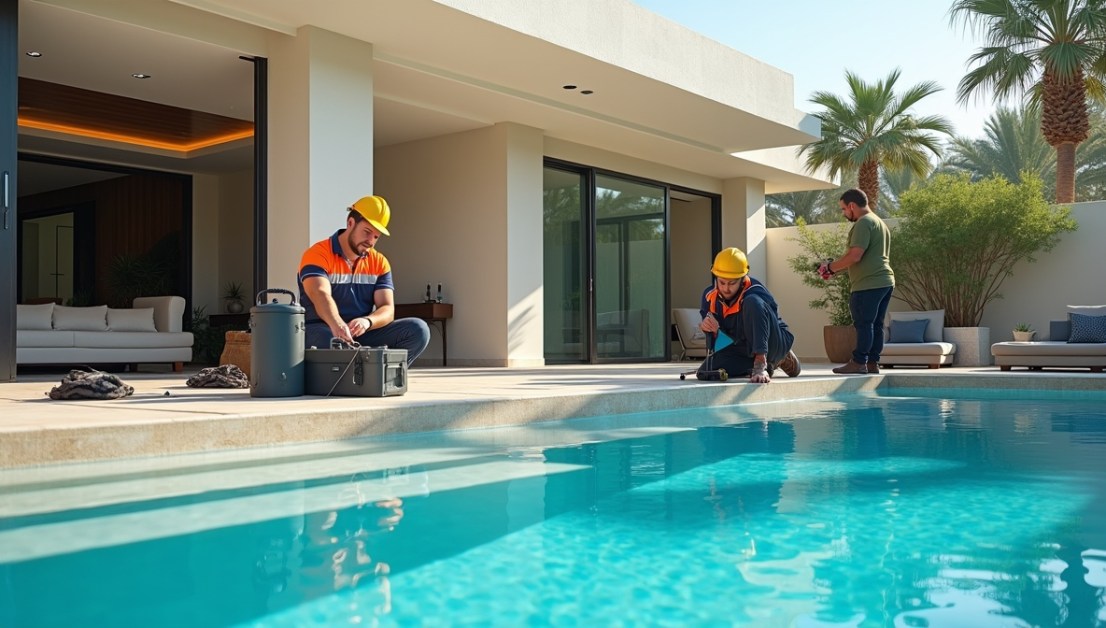
Routine maintenance is often where homeowners notice the biggest difference.
The smooth surface of fiberglass generally makes brushing and cleaning easier. Concrete pools can also be straightforward to maintain, but the chosen finish, grout condition, circulation design, and water balance influence the workload.
Neither shell eliminates the need for proper water treatment. Chlorine and pH must be monitored, filtration must run correctly, and debris should be removed promptly. CDC guidance recommends routine testing of disinfectant and pH for residential pools, with pH maintained at 7.0–7.8 under its guidance.
Dubai's heat and sunlight can increase operational pressure, while dust adds a continuous source of contamination. A maintenance plan should therefore include water testing, filter cleaning, pump inspection, skimmer baskets, brushing where needed, tile or gelcoat inspection, and equipment checks.
The practical advantage of fiberglass is usually easier surface care, not "maintenance-free ownership."
For either construction type, poor water chemistry can shorten the life of finishes and equipment. A professional maintenance schedule is therefore an investment in the whole pool rather than simply a cleaning service.
Cost in Dubai: Look Beyond the Starting Quote
There is no single official 2026 price for a residential pool in Dubai. Market guides show wide ranges because size, excavation, access, finishes, equipment, approvals, and landscaping can change the final figure substantially.
As an indicative market reference, Property Finder's 2026 guide places fiberglass pools from around AED 60,000 and standard concrete villa pools from around AED 120,000, while noting that final prices vary by project. These figures should not be treated as contractor quotations. When comparing quotes, request a line-by-line scope. Confirm whether excavation, structural work, waterproofing, coping, deck, filtration, lighting, automation, drainage, permits, testing, commissioning, and landscaping are included.
A quotation that looks cheaper may simply exclude more items.
What a professional quote should clearly identify
Pool dimensions and water depth.
Shell or structural construction method.
Interior finish and warranty.
Pump and filtration specifications.
Disinfection system.
Electrical and lighting scope.
Excavation and soil-related allowances.
Decking and coping.
Drainage.
Approvals and consultant responsibilities.
Testing and commissioning.
After-sales maintenance.
This makes an accurate comparison possible and reduces the risk of unexpected costs during construction.
Lifespan, Repairs and Long-Term Value
A well-built concrete shell can serve for decades, but its interior finish may require renovation during the pool's life. Fiberglass shells are also long-lived when correctly manufactured, installed, and maintained, although the gelcoat is a finish that can age and may eventually need professional attention.
This creates an important ownership question: are you comparing shell lifespan or the condition of the whole pool system?
A pool is a collection of components: shell, waterproofing, finish, pipes, pump, filter, valves, lights, automation, drains, and surrounding hardscape. Any of these can require replacement before the shell does.
For long-term ownership, keep records of installation specifications, equipment models, warranties, water-treatment history, and repairs. Those records make future servicing easier and can help demonstrate that the pool has been professionally maintained.
Concrete also offers an important renovation advantage. If the owner later wants a new finish, upgraded lighting, modern filtration, or additional water features, a professionally engineered concrete structure can provide considerable flexibility for refurbishment.
Fiberglass, meanwhile, can be attractive to owners who value predictable construction and simpler routine surface care.
Approvals, Safety, and Dubai Site Requirements
Pool construction should be treated as a regulated building and safety project, not simply a landscaping job.
Dubai Municipality provides a service for approval of private and public swimming-pool drawings and states that approval should be obtained before construction. Its technical guidance addresses deck areas, barriers, drainage, filtration, and other safety requirements.
For example, published Dubai Municipality guidance specifies a minimum 1.2 m barrier with a self-closing gate when the pool area is closed. Its pool-plan guidance also addresses non-slip surrounding surfaces, drainage, and filtration provisions.
Planning item
Why it matters
Pool drawing approval
Helps establish compliance before construction
Safe pool enclosure
Controls access when the pool is not in use
Non-slip deck
Reduces slip risk around wet areas
Drainage
Helps manage water around the pool
Filtration design
Supports water quality and system performance
Plant-room ventilation
Important for equipment areas
Depth and safety markings
Helps users understand pool conditions
Do not assume the contractor's verbal promise is enough. Ask for the approval pathway, responsible consultant, approved drawings, inspection requirements, and completion documentation.
The exact requirements can depend on the property, use, and authority jurisdiction, so verify the current rules before work begins.
Equipment Matters Almost as Much as the Shell
Two identical-looking pools can have very different running costs because of their equipment.
Prioritize correctly sized circulation, filtration, and disinfection systems rather than choosing equipment purely by brand or horsepower. Variable-speed pumping is also worth evaluating because pump energy consumption depends heavily on operating speed and runtime.
Consider:
variable-speed circulation;
automatic chlorine or dosing control;
quality filtration;
salt chlorination where appropriate;
pool-cover options to reduce evaporation;
automated water-level management;
efficient LED lighting;
remote monitoring;
a pool chiller if summer water temperature is a concern.
The U.S. Department of Energy continues to address energy-efficiency requirements for dedicated-purpose pool pump motors, while its technical material demonstrates how pump speed can substantially affect electricity consumption.
The best equipment package is not necessarily the most expensive one. It is the one correctly sized for your pool, operating schedule, and maintenance strategy.
For Dubai homeowners, it is also worth discussing summer water temperature before construction. If cool swimming water is important during the hottest months, plan for temperature management from the beginning rather than trying to retrofit it after the plant room has been completed.
A simple decision framework
Choose fiberglass when:
Installation speed is important;
The site suits a standard pool shape;
Easy surface cleaning is a priority;
You want a relatively predictable factory-made shell;
Extensive custom architectural features are unnecessary.
Choose concrete when:
The pool must fit a specific architectural layout
You want an infinity or overflow design;
Custom depths or unusual shapes are required;
Premium tile or bespoke finishes are important;
Future renovation flexibility matters.
Neither option should be selected from price alone. The contractor's engineering capability, installation method, equipment specification, warranty, and aftercare can materially affect the result.
FAQs
Is fiberglass suitable for Dubai's climate?
Yes. A quality fiberglass pool can perform well in the UAE when the shell, installation, drainage, and equipment are correctly specified and maintained.
Is a concrete pool more durable than fiberglass?
A properly engineered concrete shell can have a very long service life, while a quality fiberglass shell can also last for decades; maintenance and installation quality matter greatly.
Which pool is cheaper to build in Dubai?
Fiberglass often has a lower starting cost, but the final price depends on size, access, finishes, equipment, approvals, and surrounding works.
Does Dubai require approval for a private swimming pool?
Dubai Municipality provides an approval service for private pool drawings, and its technical guidance sets requirements that should be checked before construction.
Which needs less maintenance?
Fiberglass generally requires less surface-related maintenance, but both pool types still need regular water testing, filtration, cleaning, and equipment servicing.
Conclusion
For Dubai homeowners, the right pool is the one that matches the property, design brief, budget, and maintenance expectations—not simply the one with the lowest initial price.
Concrete remains the flexible choice for bespoke architecture, custom dimensions, premium finishes, and complex features. Fiberglass is attractive when speed, a standard design, and simpler surface care are priorities. Both can deliver excellent performance in the UAE climate when professional design, installation, and maintenance are treated as part of the investment.
Before signing a contract in 2026, compare at least two detailed proposals using identical specifications. Check the approval route, access plan, structural method, waterproofing, filtration, disinfection, drainage, warranty, and aftercare. Also ask what happens if site conditions differ from the quotation.